
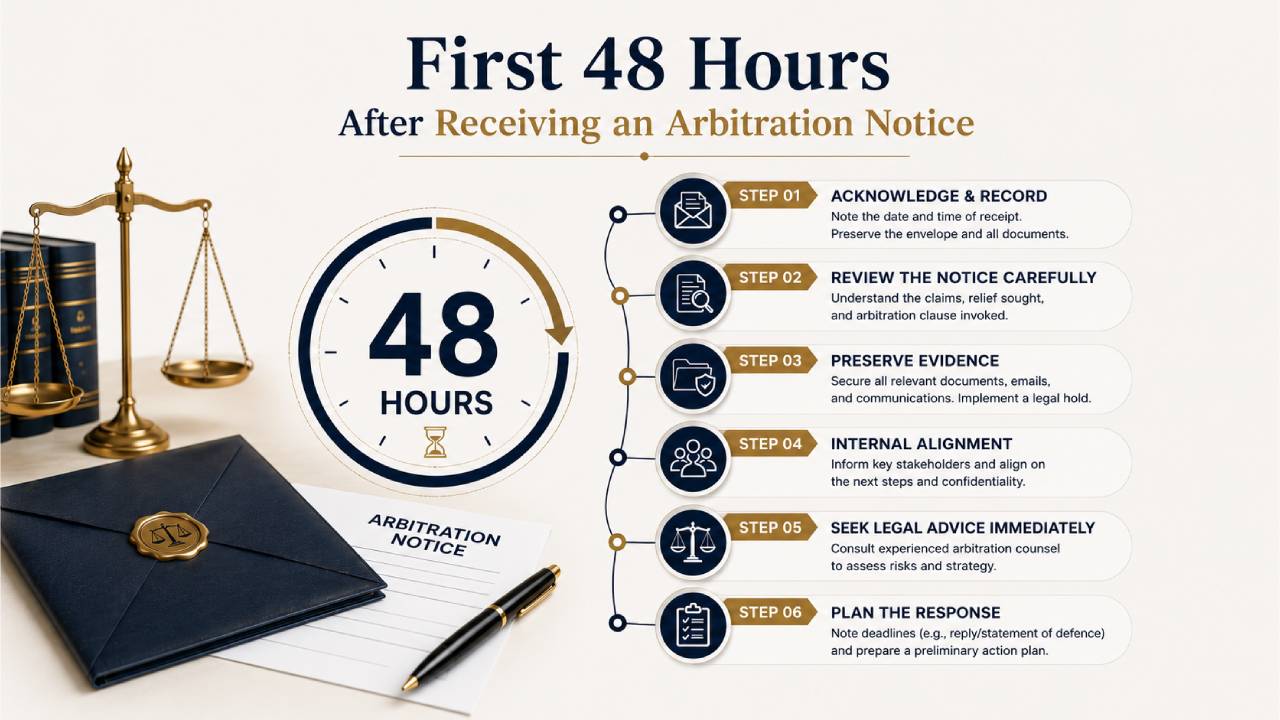
If your business receives an arbitration notice in India, do not ignore it or respond informally. The notice may trigger arbitration commencement, arbitrator appointment timelines, limitation issues, jurisdictional objections and urgent interim-relief decisions. Before replying, review the arbitration clause, preserve proof of receipt, examine the proposed appointment process, identify counterclaims and decide whether court protection under Section 9 is required.
Key Takeaways
- An arbitration notice may commence arbitral proceedings under Section 21 of the Arbitration and Conciliation Act, 1996, unless the parties have agreed otherwise.
- The date and mode of receipt should be preserved because they may affect appointment timelines and later court proceedings.
- A reply is usually advisable, but it should not contain admissions, waiver of objections or casual acceptance of a proposed arbitrator.
- The arbitration clause must be checked for seat, venue, number of arbitrators, appointment procedure, institutional rules, governing law and pre-arbitration steps.
- A proposed arbitrator should not be accepted mechanically, especially where unilateral appointment, independence or impartiality concerns may arise.
- If the clause provides for institutional arbitration, the applicable institutional rules may affect notice, appointment, emergency relief and timelines.
- If bank guarantees, assets, machinery, receivables, goods or project rights are at risk, Section 9 interim relief should be assessed immediately.
- Counterclaims, set-off, limitation objections and jurisdictional objections should be identified before the reply is sent.
Introduction: An Arbitration Notice Is Not a Routine Legal Notice
An arbitration notice often arrives at a difficult moment in a commercial relationship. A contractor may receive a demand for delay damages. A supplier may receive a repayment claim. A developer may receive a notice proposing a sole arbitrator. A company may receive a notice invoking a dispute resolution clause in a contract signed several years ago.
The immediate question is usually practical:
“Do we need to reply, and what happens if we do not?”
That question should not be answered casually.
A notice invoking arbitration may do much more than demand payment. It may trigger commencement of arbitral proceedings, activate the contractual appointment mechanism, create a record for a future Section 11 petition, raise limitation issues, and require urgent decisions on interim protection under Section 9.
In practice, the first few days after receiving an arbitration notice can materially affect the future course of the dispute. A hurried email can create admissions. Silence may allow the opposite party to move ahead with appointment steps. Acceptance of a proposed arbitrator without review can create procedural difficulties. Delay may also weaken urgency if interim protection is later required.
This article explains what a business should check before responding to an arbitration notice in India, when to object, when to counter-nominate an arbitrator, when to consider urgent court protection, and what documents should be organised before taking a formal position.
What Is an Arbitration Notice or Notice Invoking Arbitration?
An arbitration notice, often called a notice invoking arbitration, is a formal communication by which one party states that a dispute has arisen and requests that the dispute be referred to arbitration under the arbitration clause in the contract.
In most commercial disputes, the notice will usually:
- identify the contract;
- refer to the arbitration clause;
- describe the dispute;
- mention the claims or reliefs sought;
- call upon the other side to participate in appointment of the arbitrator;
- propose a name of an arbitrator, where the contract permits it;
- reserve the sender’s right to approach court under Section 11 or other provisions.
The statutory starting point is Section 21 of the Arbitration and Conciliation Act, 1996. Unless the parties have agreed otherwise, arbitral proceedings commence on the date on which a request for the dispute to be referred to arbitration is received by the respondent.
Section 21 in brief: Unless otherwise agreed by the parties, arbitral proceedings commence on the date on which the respondent receives a request for the dispute to be referred to arbitration.
That is why the date of receipt matters. The notice is not merely a warning letter. In many cases, it is the document from which the arbitration process begins.
It may also affect limitation strategy, appointment timelines, jurisdictional objections, and the decision whether urgent interim protection is required before the arbitral tribunal is constituted.
Statutory Snapshot: Provisions to Check After Receiving an Arbitration Notice
Provision | Why It Matters |
Section 7 | Check whether there is a valid arbitration agreement. |
Section 21 | Identifies when arbitral proceedings commence, unless parties have agreed otherwise. |
Section 11 | Becomes relevant if the agreed arbitrator appointment mechanism fails. |
Section 12 | Requires arbitrator disclosures on independence and impartiality. |
Fifth and Seventh Schedules | Relevant for neutrality, disclosure and ineligibility objections. |
Section 16 | Allows the arbitral tribunal to rule on its own jurisdiction. |
Section 9 | Allows urgent court protection where interim relief is required. |
Why the Date of Receipt Matters
The date of receipt of the arbitration notice should be recorded immediately. It may later become relevant to three separate issues: commencement, appointment and court strategy.
- First, under Section 21, unless the parties have agreed otherwise, commencement of arbitral proceedings is linked to receipt of the request for arbitration by the respondent.
- Second, many arbitration clauses require the recipient to respond within a stated period, agree to appointment of a sole arbitrator, or nominate an arbitrator. The date of receipt may therefore affect the appointment timetable.
- Third, if the opposite party later files a Section 11 petition for appointment of an arbitrator, the court may examine when the notice was received and whether the agreed appointment mechanism failed.
For this reason, a business should preserve the envelope, courier tracking, email header, delivery proof, postal acknowledgment or any other proof of receipt. The date printed on the notice is not always the legally relevant date.
What Should You Do Immediately After Receiving an Arbitration Notice?
The first step is not to draft a reply. The first step is to understand what the notice has triggered. A business receiving an arbitration notice should immediately check the contract, the arbitration clause, the proposed appointment mechanism, the date of receipt, the claim amount, possible limitation objections, counterclaims and any urgent risk requiring Section 9 interim relief.
Record the date and mode of receipt
Preserve the envelope, courier tracking, email header, delivery proof or registered post acknowledgment. This may become important if there is later a dispute about commencement, limitation or arbitrator appointment.
Locate the contract and arbitration clause
Do not rely only on the wording quoted in the notice. Locate the signed contract, amendments, work orders, purchase orders, supplementary agreements, general conditions and documents incorporated by reference.
The arbitration clause should be checked for:
- seat of arbitration;
- venue;
- governing law;
- number of arbitrators;
- appointment procedure;
- arbitral institution, if any;
- pre-arbitration steps such as negotiation, conciliation or dispute board;
- notice requirements;
- language of arbitration;
- court jurisdiction clause.
If the clause provides for institutional arbitration, the institution’s rules on notice, timelines, emergency arbitrator procedure and appointment process should also be checked immediately.
Check who issued the notice and against whom
In commercial disputes, notices are sometimes issued by or against the wrong entity. This is common in group-company structures, mergers, assignments, development arrangements, franchise relationships, infrastructure contracts and supply chains.
Before responding, check whether the sender and recipient are actually parties to the arbitration agreement. Also check whether any non-signatory, merged entity, dissolved entity, special purpose vehicle or group company issue arises.
Review the claims and limitation
The claim amount should not be assessed in isolation. Review the cause of action, dates of breach, final bill, termination notice, demand, settlement discussions, part payments, acknowledgments and prior correspondence.
If the claim appears stale, inflated, premature, settled or time-barred, the reply should preserve the relevant objection.
Check the proposed arbitrator
If the notice proposes a sole arbitrator or nominates an arbitrator, do not accept the name mechanically. Review the contract, appointment mechanism, Section 12 disclosures, independence and impartiality issues, and possible unilateral appointment objections.
Assess whether urgent Section 9 relief is needed
Sometimes an arbitration notice is accompanied by a commercial threat: bank guarantee invocation, termination, asset transfer, removal of goods, project disruption, encashment of security, or diversion of receivables.
In such cases, the reply and Section 9 strategy should be assessed together. A reply may preserve rights, but it may not protect assets.
Avoid informal admissions
Informal emails or WhatsApp messages acknowledging the notice, seeking time, commenting on the claim, or accepting the proposed arbitrator may later be treated as part of the arbitration record. Such communications should be avoided unless legally reviewed.
First 48 Hours Checklist After Receiving an Arbitration Notice
Step | What to Check | Why It Matters |
1 | Date and mode of receipt | May affect commencement and appointment timelines |
2 | Contract and arbitration clause | Establishes whether arbitration has been properly invoked |
3 | Seat, venue and jurisdiction | Determines forum and court strategy |
4 | Appointment mechanism | Helps decide whether to accept, object or counter-nominate |
5 | Proposed arbitrator, if any | Independence, impartiality and unilateral appointment issues may arise |
6 | Claim amount and limitation | Helps assess whether the claim is stale, inflated or time-barred |
7 | Urgent Section 9 risk | Interim protection may be needed before the tribunal is constituted |
8 | Counterclaims and set-off | Business claims should be identified early |
9 | Documents and correspondence | The reply should be based on the complete record |
10 | Internal authority to respond | Board or management approval may be required |
Do You Have to Reply to an Arbitration Notice?
In most commercial disputes, a reply is advisable. The reply is not merely a denial; it is the first formal opportunity to define your position and preserve objections before the dispute moves further.
Depending on the facts, the response may:
- deny the claims;
- accept that disputes exist but dispute the amount claimed;
- object to the invocation of arbitration;
- object to the proposed arbitrator;
- insist on the contractual appointment procedure;
- reserve jurisdictional objections;
- raise limitation objections;
- assert counterclaims or set-off;
- place material facts on record;
- state that urgent interim relief may be pursued;
- call upon the other side to follow the agreed dispute resolution mechanism.
Silence may not always amount to admission, but it can create practical disadvantage. If the arbitration clause provides for appointment steps and the recipient does not respond within time, the opposite party may approach the court under Section 11 for appointment of an arbitrator.
At the same time, a careless reply can be worse than no reply. A business should not admit liability, accept a proposed arbitrator, or waive objections without understanding the consequences.
The reply should therefore be drafted as a strategic arbitration document. It should preserve rights, avoid admissions and position the party for the next stage of the dispute.
What Should a Reply to an Arbitration Notice Contain?
A reply to an arbitration notice should be tailored to the contract, arbitration clause, claims, appointment mechanism and commercial facts. A standard denial is rarely enough.
Depending on the facts, the reply may contain the following elements.
Preliminary position
The reply should state whether the notice is admitted, denied, disputed, defective, premature or contrary to the contract. If the recipient disputes the invocation itself, that objection should be clearly preserved.
Response to claims
The reply should respond to the broad allegations without making unnecessary admissions. It should identify whether the claim amount is denied, whether liability is disputed, whether the claim is inflated and whether material facts have been suppressed.
Jurisdictional objections
If there is an objection to the existence, scope or applicability of the arbitration agreement, it should be raised or reserved. This may include objections that the recipient is not a party, the dispute is outside the arbitration clause, mandatory pre-arbitration steps were not followed, or the notice has been issued under the wrong contract.
Limitation objections
If the claim appears stale or time-barred, the reply should preserve the limitation objection. The dates of breach, demand, final bill, termination, settlement correspondence and prior proceedings should be reviewed before a position is taken.
Arbitrator appointment response
If the notice proposes a sole arbitrator or calls upon the recipient to nominate an arbitrator, the reply must carefully address the appointment mechanism. The recipient may accept the mechanism, object to the proposed name, nominate its arbitrator, call for disclosures, or insist that appointment be made in accordance with law.
Counterclaims and set-off
If the recipient has claims arising from the same transaction or contract, those should be identified early. A business should not respond only defensively if it has unpaid invoices, damages claims, delay claims, performance claims, indemnity claims or set-off.
Reservation of rights
The reply should reserve all relevant rights and remedies, including rights to object to jurisdiction, seek interim relief, oppose appointment, raise counterclaims and rely on additional documents.
Section 9 or urgent relief position
If there is a risk of bank guarantee invocation, asset dissipation, removal of goods, transfer of property, termination or frustration of recovery, the reply may need to reserve the right to seek Section 9 interim protection.
A well-drafted reply should therefore do more than deny the claim. It should protect the recipient’s procedural, jurisdictional, commercial and evidentiary position.
Before responding to an arbitration notice, it is advisable to have the notice, contract, arbitration clause and proposed appointment mechanism reviewed together. A reply sent without this review may unintentionally waive objections or create admissions.
The 30-Day Appointment Window: Why Timing Matters
Many arbitration notices call upon the other party to agree to appointment of a sole arbitrator or nominate an arbitrator within a specified period. This deadline should be taken seriously, but the applicable timeline depends on the arbitration clause and the structure of the tribunal.
Section 11 of the Arbitration and Conciliation Act, 1996 deals with appointment of arbitrators where the parties fail to agree or where the agreed appointment mechanism fails. In cases involving a sole arbitrator, failure to agree within 30 days from receipt of a request from the other party may allow appointment to be made by the court or its designated person or institution, depending on the statutory framework and the nature of the arbitration.
Where the clause provides for a three-member tribunal, the sequence may be different. Each party may be required to nominate one arbitrator, and the two nominated arbitrators may then appoint the presiding arbitrator. The applicable timeline should therefore be checked against the arbitration clause and Section 11.
The practical point is straightforward:
Do not allow the appointment window to pass without a considered response.
If the other side has proposed an arbitrator, the recipient should check:
- whether the contract permits that mode of appointment;
- whether the proposed arbitrator is independent and impartial;
- whether the proposed appointment is unilateral or invalid;
- whether the proposed arbitrator has made proper disclosures;
- whether the dispute should be referred to a sole arbitrator or a three-member tribunal;
- whether a counter-nomination is required;
- whether the claim itself is premature, stale or outside the arbitration clause.
In Arif Azim Co. Ltd. v. Aptech Ltd., (2024) 5 SCC 313 : 2024 INSC 155, the Supreme Court considered the limitation period for filing a Section 11 application and the relevance of a valid notice invoking arbitration. The case is useful for the proposition that invocation, failure or refusal to appoint, and limitation for Section 11 proceedings must be examined carefully before the matter reaches the court appointment stage.
For a business, the appointment period is a control point. Missing it may shift the dispute from negotiation over appointment to a court-led Section 11 proceeding.
Should You Accept, Object to, or Counter-Nominate the Proposed Arbitrator?
A party should not automatically accept the arbitrator proposed in an arbitration notice. The proposed appointment must be tested against the contract, the Arbitration and Conciliation Act, 1996, and the principles governing independence, impartiality and unilateral appointment.
An arbitration notice may propose the name of a sole arbitrator. It may also nominate one arbitrator and call upon the other party to nominate its arbitrator. Sometimes it may state that if there is no response, the sender will proceed with appointment.
This part of the notice must be read carefully. The proposed appointment may be valid, invalid, premature or contrary to the agreed procedure.
Key questions include:
- Does the arbitration clause provide for a sole arbitrator or a three-member tribunal?
- Who has the power to appoint?
- Is the appointment mechanism unilateral?
- Is the proposed arbitrator connected with the other party?
- Has the proposed arbitrator made disclosures under Section 12?
- Do any Fifth Schedule or Seventh Schedule concerns arise?
- Is the appointing authority itself ineligible?
- Is court appointment under Section 11 likely to be required?
The Supreme Court’s decisions in TRF Ltd. v. Energo Engineering Projects Ltd., (2017) 8 SCC 377 and Perkins Eastman Architects DPC v. HSCC (India) Ltd., (2020) 20 SCC 760 are important in this area.
In TRF Ltd., the Supreme Court held that once a person becomes ineligible to act as an arbitrator, he cannot nominate another person as an arbitrator. In Perkins Eastman, the Supreme Court extended the principle in the context of unilateral appointment of a sole arbitrator and held that a person interested in the outcome should not have exclusive control over appointment of the sole arbitrator.
This does not mean every appointment proposed in a notice is invalid. It means the appointment mechanism must be examined before responding.
A wrong response can create avoidable complications. For example, a party may inadvertently accept an arbitrator, waive objections, or miss the opportunity to insist on a neutral appointment process.
Can You Object to Arbitration Itself?
Yes, in appropriate cases. The important question is not only whether an objection exists, but where and when it should be raised.
The first threshold issue is whether there is an arbitration agreement within the meaning of Section 7 of the Arbitration and Conciliation Act, 1996. If there is no valid arbitration agreement, or if the dispute does not fall within its scope, the recipient may need to preserve that objection in the reply.
A business receiving an arbitration notice should check whether:
- there is a valid arbitration agreement;
- the recipient is party to the arbitration agreement;
- the sender is party to the arbitration agreement;
- the arbitration clause covers the present dispute;
- mandatory pre-arbitration steps were followed;
- the claim is time-barred;
- the claim has already been settled;
- there is a no-dues certificate, discharge, accord and satisfaction issue;
- the dispute is arbitrable;
- the notice is defective or premature;
- the proposed claims fall outside the contract.
Some objections may be taken before the arbitral tribunal under Section 16, which embodies the principle that the tribunal can rule on its own jurisdiction. Other objections may become relevant at the Section 11 stage, especially where there is a clear issue regarding existence of the arbitration agreement or where claims are ex facie time-barred.
In Duro Felguera S.A. v. Gangavaram Port Ltd., (2017) 9 SCC 729, the Supreme Court explained the limited scope of court enquiry at the Section 11 stage after the 2015 amendment, principally around the existence of the arbitration agreement.
In BSNL v. Nortel Networks India Pvt. Ltd., (2021) 5 SCC 738, the Supreme Court held that while limitation is ordinarily a matter for the arbitral tribunal, a court may refuse reference in cases where the claims are ex facie time-barred and deadwood.
In NTPC Ltd. v. SPML Infra Ltd., (2023) 9 SCC 385, the Supreme Court reiterated that while referral courts should ordinarily leave disputed issues to the arbitral tribunal, they may decline reference where the dispute is plainly non-existent, deadwood, or where there is no subsisting dispute to be referred. This may be relevant where an arbitration notice is issued despite a prior settlement, discharge, or closure of claims.
For businesses, the practical lesson is clear. Objections should not be scattered casually through a reply. They should be identified, preserved and raised at the correct stage.
What If the Claim Is Old or Time-Barred?
Limitation should be assessed immediately after receiving an arbitration notice. A claim may appear old because the underlying contract was executed years ago, but limitation does not depend only on the date of the contract.
It may depend on the date of breach, final invoice, termination, denial of liability, final bill, acknowledgment, settlement correspondence, part payment, or other facts.
The recipient should review:
- when the cause of action arose;
- when payment became due;
- whether there was any acknowledgment of liability;
- whether there was part payment;
- whether the claim was previously settled;
- whether a no-dues certificate was issued;
- whether any prior proceedings affected limitation;
- whether the claim is ex facie time-barred.
In many cases, limitation may be decided by the arbitral tribunal. However, in very clear cases, limitation may also become relevant at the Section 11 stage. This is why a limitation objection should not be missed in the reply.
The reply should avoid language that revives or acknowledges a stale claim unless that is a deliberate legal position.
Should You Consider Section 9 Interim Relief After Receiving an Arbitration Notice?
Yes, if the notice reveals an immediate commercial risk. A business should consider Section 9 interim relief where a mere reply to the arbitration notice will not protect assets, securities, goods, receivables or project rights.
Many businesses treat the arbitration notice and interim relief strategy as separate issues. That can be a mistake. Sometimes the notice is accompanied by a threat that the opposite party will invoke a bank guarantee, terminate the contract, remove goods, transfer property, take over project material, or dissipate assets.
In such cases, merely replying to the notice may not be enough. The business may need to consider urgent interim protection under Section 9 before the arbitral tribunal is constituted.
Section 9 may be relevant where:
- a bank guarantee or performance security may be invoked;
- assets may be transferred;
- machinery or goods may be removed;
- receivables may be diverted;
- property or development rights may be affected;
- project access may be blocked;
- award recovery may be frustrated later.
The decision to file Section 9 should be made quickly, but not casually. The party must show urgency, risk, documents and a clear connection with arbitration. If the notice is accompanied by threats of bank guarantee invocation, termination, removal of goods or asset movement, the arbitration notice response and Section 9 strategy should be assessed together.
What Documents Should You Collect Before Replying?
A strong response begins with a complete record. The reply should not be drafted only on the basis of the arbitration notice. The contract and correspondence often matter more than the notice itself.
Before replying to an arbitration notice, a business should collect and organise the following documents:
Document | Why It Matters |
Arbitration notice | Shows date, claims, invocation language and appointment proposal |
Proof of receipt | Important for Section 21 and appointment timelines |
Main contract | Contains arbitration clause and substantive obligations |
Amendments and supplementary agreements | May alter scope, amount, timelines or dispute mechanism |
Purchase orders / work orders | Establish transaction-specific obligations |
Invoices and payment records | Relevant for claim, counterclaim, set-off and limitation |
Running bills / final bills | Important in construction and infrastructure disputes |
Default notices / termination notices | Shows prior dispute history and breach allegations |
Emails and correspondence | Establishes admissions, objections, performance issues and chronology |
WhatsApp and electronic communications | Relevant where business discussions happened informally |
Bank guarantee / security documents | Relevant for urgent interim relief |
Settlement communications | May affect liability, limitation or without prejudice strategy |
Delivery records / site records | Relevant for supply, project and construction disputes |
Board authorisation | May be required for formal legal action |
Counterclaim documents | Helps preserve claims before the arbitration begins |
The document review should answer four questions:
- What is the legal relationship between the parties?
- What does the arbitration clause actually require?
- What claims and counterclaims exist?
- What objections must be preserved immediately?
A response prepared without documents may miss jurisdictional objections, limitation points, set-off, counterclaims, appointment defects or interim relief requirements.
Practical Decision Framework: How to Respond to an Arbitration Notice
A business can use the following framework before deciding its response.
Step 1: Is there a valid arbitration clause?
If there is no arbitration clause, or if the recipient is not party to the arbitration agreement, the reply should preserve jurisdictional objections.
Step 2: Does the clause cover this dispute?
If the claim falls outside the contract or outside the arbitration clause, that objection should be raised.
Step 3: Has the correct procedure been followed?
Check whether pre-arbitration steps, notice requirements, negotiation clauses, institutional rules or appointment procedure have been followed.
Step 4: Is the claim within limitation?
If the claim appears stale or time-barred, limitation should be reviewed and preserved.
Step 5: Is the proposed arbitrator validly appointed?
Check whether the proposed appointment is consistent with the contract and the law on independence, impartiality and unilateral appointment.
Step 6: Are urgent protective orders required?
If there is risk to assets, bank guarantees, property, goods, receivables or project rights, Section 9 should be evaluated immediately.
Step 7: Are there counterclaims?
Assess whether the business has monetary claims, damages claims, set-off, delay claims, quality claims, indemnity claims or unpaid invoices.
Step 8: What should the reply preserve?
The reply should preserve all relevant rights, objections, counterclaims and remedies without making unnecessary admissions.
Common Mistakes Businesses Make After Receiving Arbitration Notices
Many businesses weaken their position within the first few days after receiving an arbitration notice. The mistakes are usually avoidable.
Ignoring the notice
Ignoring the notice may allow the other party to proceed with appointment steps or approach the court under Section 11. It may also create the impression that the recipient is not serious about participating in the appointment process.
Sending a casual email reply
A short email saying “we will pay soon”, “we will settle”, “we agree to arbitration”, or “we have no objection” may later be relied upon in the arbitration record. Informal replies should be avoided unless carefully considered.
Admitting liability
The reply should not admit the claim amount, breach, delay, defective performance or responsibility unless that is a deliberate legal position.
Accepting a proposed arbitrator without review
The proposed arbitrator may not have been appointed in accordance with the contract. There may also be independence, impartiality, unilateral appointment or disclosure issues.
Missing the appointment timeline
If the notice triggers an appointment window, the date should be diarised immediately. Missing the window may allow the opposite party to move for court appointment.
Failing to raise jurisdiction or limitation objections
If objections exist, they should be preserved. A reply that deals only with the merits may miss threshold objections that matter later.
Not considering Section 9 urgency
If the opposite party is taking steps that may defeat the arbitration, a mere reply may not protect the business. Section 9 may need to be considered.
Forgetting counterclaims
Businesses often respond defensively and forget to assess their own claims. Counterclaims, set-off, damages, unpaid invoices, delay claims and contractual breaches should be reviewed before replying.
Treating the notice as a template exercise
An arbitration notice reply is not a standard legal format. It must be tailored to the contract, claims, arbitration clause, appointment mechanism, limitation position and commercial risk. A weak response can create avoidable problems later. The safer approach is to review the notice, contract, appointment clause, claims, limitation, documents and possible interim relief strategy before sending a reply.
How Rishabh Gandhi and Advocates Assists With Arbitration Notice Responses
Rishabh Gandhi and Advocates advises and represents businesses in arbitration-related disputes, including matters at the notice, invocation, arbitrator appointment, interim relief, arbitral proceedings, award challenge and enforcement stages. At the arbitration notice stage, the firm typically assists with reviewing the notice and contract, examining the validity and scope of the arbitration clause, identifying the seat and appointment mechanism, assessing limitation and stale claim issues, advising on whether to accept or object to the proposed arbitrator, preserving jurisdictional objections, evaluating Section 9 requirements, preparing the reply, identifying counterclaims and advising on Section 11 strategy where required. This stage matters because the first response often becomes part of the record for later proceedings. A properly drafted reply can prevent admissions, preserve objections, address appointment defects, protect counterclaims and prepare the ground for Section 9 or Section 11 proceedings if required.
Conclusion
An arbitration notice should not be ignored or answered casually. It may trigger appointment timelines, limitation issues, jurisdictional objections, interim relief strategy and the course of the arbitration itself. The most important step is to avoid a hurried reply. The notice, contract, arbitration clause, appointment mechanism, claim documents, limitation position and possible counterclaims should be reviewed before a formal response is sent. A careful response at this stage can materially improve the party’s position before the dispute moves further.
Received an arbitration notice? Share the notice, contract, arbitration clause and key correspondence with Rishabh Gandhi and Advocates before sending your response.
FAQ: Arbitration Notice in India
What is an arbitration notice in India?
An arbitration notice is a formal communication by which one party invokes the arbitration clause and requests that the dispute be referred to arbitration. It usually identifies the contract, dispute, claims and proposed appointment procedure.
Is an arbitration notice mandatory before arbitration?
In most cases, a notice invoking arbitration is important because Section 21 links commencement of arbitral proceedings to receipt of the request for arbitration, unless the parties have agreed otherwise.
What should I do after receiving an arbitration notice?
Record the date of receipt, preserve the notice, locate the contract and arbitration clause, check the appointment mechanism, assess limitation and claims, and avoid sending informal admissions before legal review.
Do I have to reply to an arbitration notice?
A reply is usually advisable. It may accept arbitration while disputing claims, object to appointment, reserve jurisdictional or limitation objections, or assert counterclaims.
What happens if I ignore an arbitration notice?
Ignoring the notice may allow the other party to proceed with appointment steps or approach the court under Section 11. It may also reduce your opportunity to raise timely objections.
What is the 30-day period after receiving an arbitration notice?
Where parties must agree on a sole arbitrator, failure to agree within 30 days from receipt of the request may allow the other party to seek court appointment under Section 11. For a three-member tribunal, nomination and presiding-arbitrator timelines may operate differently and should be checked against the clause.
Can I object to the arbitrator proposed in the notice?
Yes. The proposed appointment should be reviewed against the arbitration clause, Section 12 disclosure requirements, independence and impartiality concerns, and unilateral appointment principles.
Can I object that the claim is time-barred?
Yes. Limitation should be assessed immediately. Some limitation objections may be raised before the tribunal, and in very clear cases may become relevant at the Section 11 stage.
Can I raise counterclaims in response to an arbitration notice?
Yes. If you have counterclaims arising from the same contractual relationship, they should be identified early and preserved in the response strategy.
Should I consider Section 9 after receiving an arbitration notice?
Yes, if urgent protection is required against bank guarantee invocation, asset transfer, removal of goods, termination, project disruption or frustration of recovery before the tribunal is constituted.
Which court appoints an arbitrator if parties do not agree?
Depending on whether the arbitration is domestic or international commercial arbitration, and depending on the seat and contract, the High Court, Supreme Court or a designated person or institution may become relevant under Section 11.
Should a lawyer draft the reply to an arbitration notice?
In commercial disputes, it is advisable. The reply may affect appointment, jurisdictional objections, limitation, counterclaims, Section 9 strategy and the overall arbitration roadmap.
Sources / Authorities
- Arbitration and Conciliation Act, 1996 — Sections 7, 9, 11, 12, 16 and 21.
- Fifth and Seventh Schedules to the Arbitration and Conciliation Act, 1996.
- TRF Ltd. v. Energo Engineering Projects Ltd., (2017) 8 SCC 377.
- Duro Felguera S.A. v. Gangavaram Port Ltd., (2017) 9 SCC 729.
- Perkins Eastman Architects DPC v. HSCC (India) Ltd., (2020) 20 SCC 760.
- BSNL v. Nortel Networks India Pvt. Ltd., (2021) 5 SCC 738.
- TPC Ltd. v. SPML Infra Ltd., (2023) 9 SCC 385.
- Arif Azim Co. Ltd. v. Aptech Ltd., (2024) 5 SCC 313 : 2024 INSC 155.
Disclaimer
This article is for general information only and does not constitute legal advice. Arbitration strategy depends on the contract, notice, correspondence, limitation position, appointment mechanism and facts of the dispute. Specific legal advice should be obtained before responding to an arbitration notice or taking steps in arbitration-related proceedings.
Related Articles
• Section 9 Arbitration Interim Relief in India
• Section 11 Petition for Appointment of Arbitrator in India
• Section 34 Challenge to an Arbitral Award in India
• Section 36 Enforcement of Arbitral Awards in India
• Construction Contract Arbitration in India